VYOM
Autonomous Industrial Mobile Robot
An autonomous mobile robot platform concept engineered for indoor factory and warehouse material transfer. Integrates 2D LiDAR SLAM, obstacle avoidance, and split compute between high-level navigation and real-time motor control.
The Environment
Operational requirements within structured indoor industrial facilities
Indoor industrial environments such as warehouses, manufacturing plants, and logistics distribution hubs present structured yet dynamic operating conditions. Moving materials reliably through these spaces requires autonomous platforms engineered around five core spatial capabilities:
Traversing rectilinear warehouse aisles and shared corridors reliably while maintaining continuous spatial alignment.
Identifying moving factory operators, material handling equipment, and stationary pallets to avoid collisions.
Extracting meaningful visual context from the surroundings, including optical fiducial tags for docking and terminal handling.
Tracking atmospheric metrics, air quality, and hazardous thermal shifts across enclosed plant sectors.
Operating with deterministic fail-safe mechanisms, dynamic deceleration zones, and emergency stop interlocks to ensure safe coexistence with facility personnel.
System Concept
Ordered progression from sensory perception to physical action
The autonomy architecture of VYOM is conceived as an ordered progression from raw spatial intake through physical execution. Each stage isolates responsibilities to ensure predictable, safe operation within indoor industrial spaces.
PERCEPTION
“Understanding people, obstacles, tags and relevant environmental information through sensors and vision.”
Represents an isolated conceptual subsystem within the autonomous robotics hierarchy, establishing clean abstraction boundaries between sensory intake, analytical modeling, and physical motor torque.
Architectural Boundary: These represent fundamental conceptual system layers. In keeping with factual engineering rigor, they define functional requirements and subsystem boundaries rather than claiming specific unverified planner or benchmark implementations.
Perception
Spatial observation and multi-target entity categorization
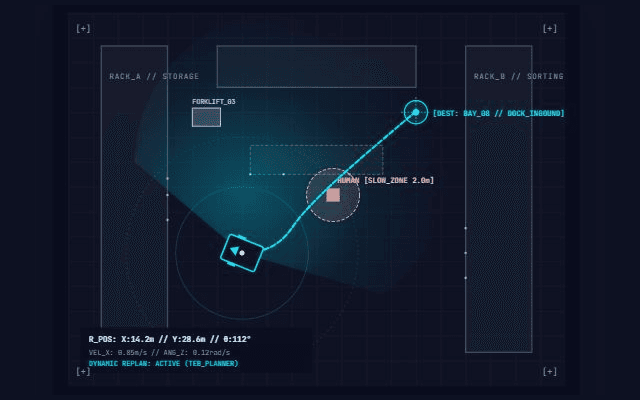
Projects a protective spatial envelope to trigger deceleration and prevent close encounters.
The Platform
Subsystem integration and dual-tier compute topology
Target design specification for structural sizing and material transport capacity. Subject to physical prototype validation.
Mobile Base
Physical locomotion and structural load bearing
Differential drive chassis engineered to accommodate industrial payloads across level factory floors.
Onboard Compute
Hierarchical split-processing architecture
Separates high-level perception and path formulation from deterministic real-time motor actuation.
Perception Suite
Spatial boundary acquisition & visual feature tracking
Combines planar laser scanning for boundaries with optical cameras for entity and tag recognition.
Navigation Layer
Occupancy mapping & motion planning
Coordinates coordinate transformations, occupancy grid mapping, and trajectory guidance.
Environmental Sensing
Corridor climate and atmospheric monitoring
Collects ambient industrial telemetry including temperature, particulate matter, and safety hazards.
Inter-Process Bridge
Low-latency communication substrate
Bridges ROS 2 navigation nodes on the compute accelerator to low-level microcontroller motor drivers.
Safety-Oriented Systems
Hardware and software failsafe interlocks
Hardware emergency stop circuits, deceleration envelopes, and watchdogs ensuring safe aisle coexistence.
Hosts asynchronous compute-intensive processes: 2D LiDAR point ingest, occupancy costmap generation, computer vision object classification, and global trajectory planning under ROS 2.
Executes time-critical low-latency loops: motor PID velocity control, quadrature wheel encoder tracking, emergency stop hardware monitoring, and deterministic fail-safe triggers.
Safety & Environment
Atmospheric monitoring and thermal hazard detection capabilities
Air Quality & Particulate
Monitors warehouse ambient air quality and volatile concentrations in enclosed bays.
Identifies deteriorating air quality conditions and alerts maintenance personnel.
Thermal & Climate
Tracks atmospheric shifts and hot spots across material storage aisles.
Maintains climate awareness for temperature-sensitive inventory and machine overheating.
Smoke & Particulate Detection
Detects early smoke development along active transit corridors.
Initiates path avoidance around affected aisles and broadcasts immediate facility alerts.
Flame & Thermal Signatures
Monitors unexpected open flame or rapid heat spikes within the operating perimeter.
Triggers immediate mobile base halt, safe standstill interlock, and emergency telemetry dispatch.
Smoke and fire capabilities within VYOM are conceived strictly around early detection, localized corridor alert broadcasting, and obstacle rerouting. Any supplementary water-mist or extinguishing mechanisms discussed in the concept architecture represent prospective safety subsystem exploratory designs, rather than validated operational firefighting hardware.
Industrial Environment
Structured indoor facility layout, transit corridors, and zoning
VYOM is designed for structured indoor industrial environments—such as manufacturing floors, distribution centers, and warehouse aisles—navigating predictable geometries while adaptively reacting to dynamic human and vehicular presence.
Nodal System
Distributed stationary checkpoint beacons for localized sensing
The conceptual architecture includes auxiliary distributed nodes placed at fixed checkpoints throughout the facility. These stationary units complement the mobile robot by gathering localized environmental telemetry and providing spatial reference signals along transit corridors.
ESP-Based Controller
Low-power microcontroller handling periodic sensor reads and telemetry packaging.
Environmental Sensing
Monitors ambient air quality and volatile atmospheric shifts at fixed points.
Temperature Sensing
Measures local thermal gradients across high-density storage bays.
Infrared (IR) Sensing
Short-range obstacle / presence detection and line-of-sight monitoring.
Battery Power Source
Self-contained DC power enabling flexible wall or column mounting without complex cabling.
Industrial Enclosure
Ruggedized casing protecting electronics from warehouse dust and mechanical contact.
Docking & Control
Terminal replenishment lifecycle and operator interaction modes
ROBOT
Approaches designated terminal charging zone under broad LiDAR navigation.
DOCK
Engages close-range optical fiducial alignment to mate contact terminals with the base.
CHARGE
Initiates power transfer via charging pads while maintaining low-power sleep telemetry.
READY
Re-engages navigation systems upon replenishment to accept queued dispatch tasks.
Provides direct manual positioning for maintenance, maintenance relocation, payload alignment verification, or exceptional obstacle clearance where autonomy is temporarily suspended.
Executes autonomous route tracking between warehouse storage bays, reacting dynamically to pedestrians and stationary obstacles while maintaining adherence to facility speed limits.
Onboard Touchscreen HMI Concept: An integrated local display architecture conceived for on-chassis operator inspection, mode toggling, and e-stop release confirmation directly at the robot.
Technology Stack
Verified technologies associated with the VYOM platform
NVIDIA Jetson
Hosts high-level perception, vision models, occupancy costmaps, and navigation node coordination.
ROS 2 Middleware
Pub/sub messaging substrate connecting sensor feeds, coordinate transforms, and velocity commands.
ESP32 Controller
Dedicated deterministic execution of motor PID loops, wheel encoders, and hardware e-stop triggers.
LiDAR & Vision
Planar laser scanning for geometric boundaries paired with camera streams for visual classification.
My Contribution
Individual engineering responsibilities and system development scope
Defined the overall system structure and interaction between mobility, perception, compute, sensing and software layers.
Worked on selecting and evaluating technologies for compute, navigation, perception and system integration.
Contributed to the computer-vision and sensing architecture for people, obstacle, fire and smoke detection.
Worked across hardware and software boundaries to define how the robotic platform, compute and sensing subsystems interact.
Contributed to architecture, system specifications, component selection and engineering documentation, supporting project maturation for the CRiEYA incubation benchmark.
Project Development
Ordered technical progression from initial formulation to hardware development
SYSTEM CONCEPT
Formulating functional requirements for autonomous material transport in indoor facilities.
ARCHITECTURE
Structuring the dual-tier compute split between high-level Jetson and real-time ESP32.
TECHNOLOGY SELECTION
Evaluating LiDAR sensors, vision compute units, motor controllers, and middleware standards.
PROTOTYPE / DEVELOPMENT
Advancing the system into hardware fabrication and prototype development stage.
Current Status
Factual position within the engineering lifecycle
VYOM is being developed as an industrial autonomous mobile robot concept, with ongoing work around system architecture, perception, navigation and platform integration.
Selected for the CRiEYA L3 Funding Stage, the project is focused on physical hardware sizing, sensor validation, and software architecture maturation. It is not commercially deployed or industrially validated at scale.
SHESH
Personal Multi-Agent AI Companion Concept