AUMByte
Edge AI Crop Disease Detection System
An offline-first edge AI system engineered for agricultural micro-plots where persistent internet connectivity cannot be assumed. Combines on-device camera inference with automated cellular SMS advisories.
The Agricultural Connectivity Gap
Timely foliar diagnosis constrained by rural telecom deserts
Early visual identification of plant pathogens is critical to containing crop diseases before localized foliar infections devastate entire yields. However, smallholder farms, orchards, and rural micro-plots frequently exist in connectivity deserts with intermittent or absent broadband.
Standard precision agriculture platforms rely on sending raw images to cloud-hosted machine learning endpoints. In rural agricultural settings, this dependency creates a brittle point of failure: when connectivity drops, diagnostic capabilities halt entirely.
Rural 2G/3G networks struggle to transmit high-resolution camera images offsite, introducing delays or complete upload timeouts during critical inspection windows.
Solutions requiring complex smartphone apps, account logins, and constant data plans create significant operational barriers for smallholder growers.
Moving Intelligence to the Field
Camera acquisition to automated alert execution chain
Conventional precision agriculture solutions frequently depend on cloud computer vision backends, requiring high-bandwidth cellular links to stream images. In rural micro-plots and orchards, connectivity deserts cause these systems to fail during critical infection windows.
// Design Principle: Shift computational intelligence directly to the physical field device.
Evaluates the normalized crop image directly on localized compute without external cloud roundtrips.
Engineering Rationale: Guarantees evaluation even when rural telecom towers are unreachable or offline.
Edge-First Computation Topology
Localized inference over remote cloud roundtrips
AUMByte was architected around the core engineering hypothesis that agricultural intelligence must operate reliably at the point of capture. Instead of treating field hardware as a dumb camera streaming frames across the internet, the local edge unit houses the trained detection model directly.
Leaf evaluation occurs locally in device memory, unaffected by external server outages, API rate limits, or network downtime.
Processing occurs in real time at the plant canopy level, removing roundtrip network latency from the diagnostic cycle.
Evaluating a frame locally consumes far less power than maintaining continuous high-bandwidth wireless video transmitters in the field.
Computer Vision Foliage Inspection
Canopy viewfinder framing and symptom region localization
Foliage camera viewfinder layout with localized symptom bounding
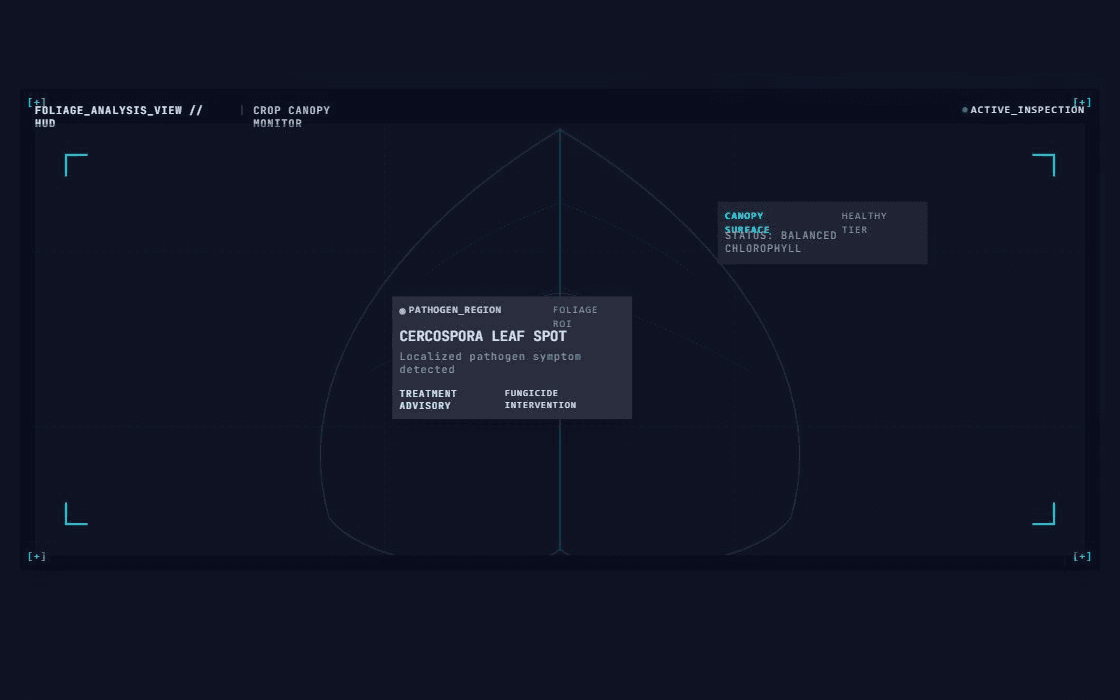
Localized bounding box isolating foliar lesions (e.g. Cercospora leaf spot symptoms).
Offline Resilience & Cellular SMS
Lightweight advisory channel engineered for universal access
Agricultural micro-plots and orchards frequently exist in fringe reception areas where heavy cloud apps and video feeds are unusable. AUMByte was designed to reduce dependence on continuous broadband internet connectivity by isolating the heavy vision computation locally and using SMS as a lightweight alert vector.
// Plain-text SMS operates over minimal cellular signal thresholds, enabling automated alerts without smartphone prerequisites.
Model runs directly on local edge hardware immediately following camera trigger, eliminating external transmission dependencies.
Detection classification is compressed into a compact, plain-text advisory payload formatted for standard cellular modems.
Dispatched through embedded cellular hardware using standard serial AT command handshakes over available base station links.
Delivered directly to the grower's handset as a standard text message, functioning equally well on basic feature phones.
“AUMByte Advisory: Foliar inspection in Plot B indicates localized Cercospora leaf spot symptoms on upper canopy foliage. Recommend visual confirmation and targeted intervention before next irrigation cycle.”
Physical Hardware Integration
Coupling optical sensors, edge compute, and cellular modems
AUMByte integrates software intelligence directly with field-deployable embedded hardware. The physical architecture is structured to maintain clear operational boundaries between optical acquisition, localized inference computation, system orchestration, and cellular dispatch.
Optical Camera Unit
Perception & AcquisitionFrames and acquires leaf canopy surfaces under ambient field illumination.
Edge Compute Unit
Inference EngineHosts local computer vision models to perform on-device foliar classification without cloud roundtrips.
ESP32 Controller
Hardware OrchestrationManages system triggering, power states, sensor scheduling, and serial modem handshakes.
Cellular GSM Modem
Communication ChannelExecutes AT command sequences to transmit plain-text advisory SMS over available cellular base stations.
Engineered Technology Stack
Strictly verified technologies utilized in the AUMByte prototype
Vision
Optical frame processing and foliar symptom bounding.
Edge AI
On-device model evaluation bypassing external cloud dependencies.
Hardware
Microcontroller coordination, image acquisition, and peripheral control.
Comms & Core
Serial AT-command cellular alert dispatch and core scripting runtime.
Personal Contribution & Engineering Role
Direct technical ownership across architecture, vision, and hardware integration
As the technical lead on the AUMByte project, my contributions spanned system architecture definition, computer vision prototyping, and physical embedded integration:
Designed the overall edge-first architectural topology, establishing the decoupled interfaces between camera intake, local inference compute, and modem notification.
Developed the camera-to-inference pipeline, calibrating region-of-interest extraction and foliar symptom bounding for variable field lighting conditions.
Contributed to interfacing the optical camera sensor, local compute module, and ESP32 microcontroller to enable cohesive on-device triggering.
Engineered the inference-to-SMS alert sequence, implementing serial AT command routines to format and transmit concise diagnostic advisories over cellular networks.
Assembled the integrated working prototype unit and delivered the live technical defense at the Indian Electronics & Innovation League (IEIL).
Competition Validation
National recognition at the Indian Electronics & Innovation League
1st Place Winner — Indian Electronics & Innovation League (IEIL)
Awarded first prize at the national IEIL competition for demonstrating a working embedded prototype capable of on-device foliage diagnostics and automated SMS dispatch, proving the viability of offline edge AI in connectivity-constrained agricultural environments.
Current Project Status
Factual position within the engineering lifecycle
AUMByte was successfully prototyped and validated at the competition level, confirming the feasibility of offline edge foliage classification and automatic cellular SMS alert dispatch.
The project remains a working hardware-software prototype. It is not currently deployed commercially, nor operates as an active large-scale farm network.
VYOM
Autonomous Industrial Mobile Robot